
Índice
Carbon fibre has emerged as a key material in the manufacture of military drones, due to its many advantages:
– Extreme light weight
– High strength
– Improved manoeuvrability
– Reduced detectability
These characteristics make carbon fibre an ideal material for military drones, improving not only their performance but also their survivability in hostile environments.
Military drones have revolutionised defence strategies in contemporary conflicts, offering advanced reconnaissance, surveillance and strike capabilities. Their technological evolution has enabled armed forces to execute operations with greater precision and less risk to personnel.
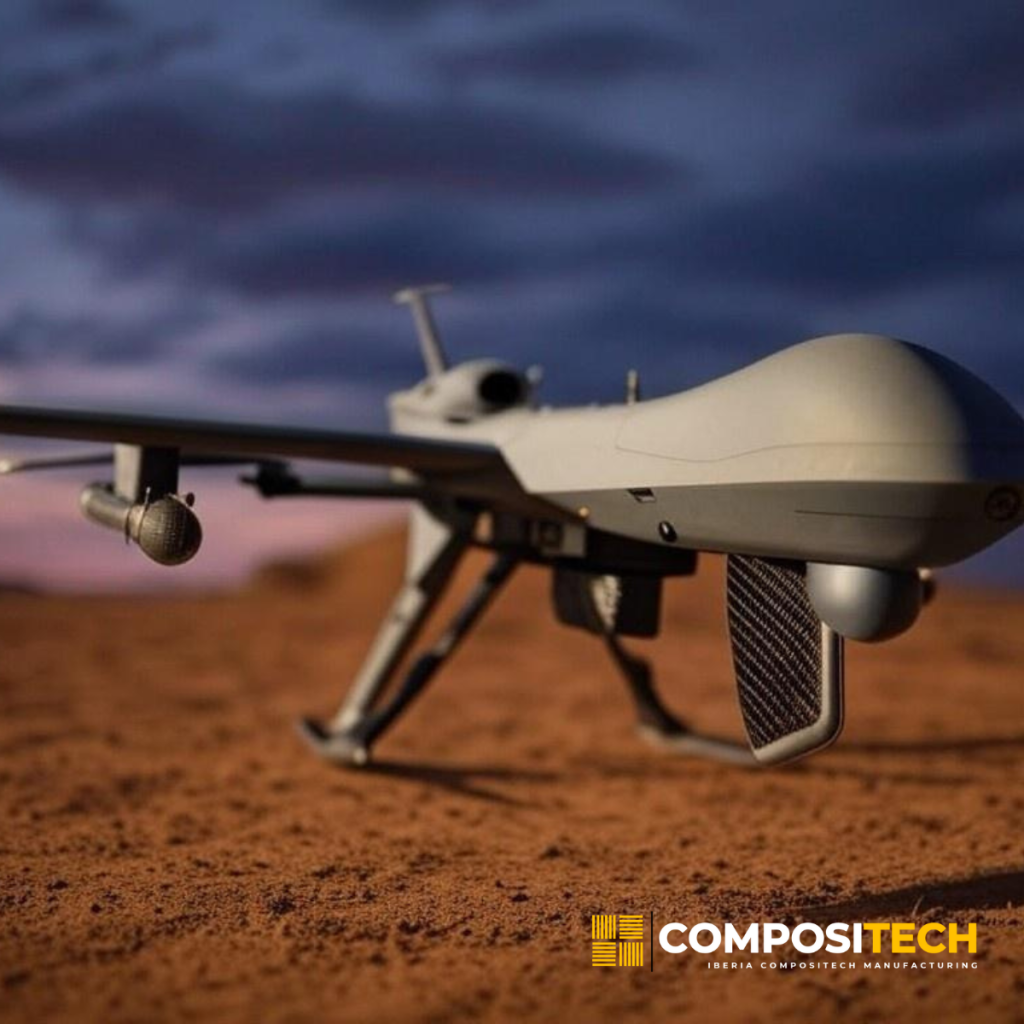
Types of military drones and their applications
1. Combat drones (UCAVs): Designed to carry out precision strikes, these unmanned aerial vehicles (UAVs) enable offensive missions without exposing human pilots to danger. Models such as the MQ-9 Reaper and the MQ-1 Predator are notable for their ability to carry weaponry and execute targeted strikes.
2. Intelligence, surveillance and reconnaissance (ISR) drones: Equipped with high-resolution sensors and cameras, these drones provide real-time data on enemy movements and terrain conditions, facilitating strategic decision-making.
3. Logistics drones: Used to transport essential supplies, such as ammunition and medical equipment, to hard-to-reach areas, ensuring the necessary support to troops on the front lines.
Recent innovations in military drones
The incorporation of artificial intelligence (AI) has enabled the development of autonomous drones capable of executing complex missions with minimal human intervention. These systems can adapt to hostile environments, track moving targets and avoid obstacles while collecting and transmitting vital data in real time.
In addition, improvements have been made to flight endurance through the integration of dual batteries and advanced power management systems, enabling prolonged mission-critical operations.
Recent cases of military drone use
In the conflict between Ukraine and Russia, drones have played a crucial role. A Ukrainian pilot proposed the use of massive swarms of drones to dismantle Russian defences, highlighting the effectiveness and economy of these devices on the battlefield.
It also documented the first case of a Ukrainian naval drone shooting down a Russian helicopter, demonstrating the versatility and lethality of these systems in military operations.
Challenges and ethical considerations
The use of military drones poses challenges in terms of security and ethics. The possibility of autonomous attacks without human intervention raises debates about liability in case of errors or collateral damage. In addition, the proliferation of commercial drones modified for military purposes poses a real threat to critical infrastructure and public safety.
Military drones continue to transform global defence strategies, offering significant advantages in terms of accuracy and risk reduction. However, their use also poses challenges that require careful consideration in terms of safety, ethics and international regulation.
aerodynamic
carbonfiber
carbonfibre
Certificacion
compositematerials
composites
Drone
EN9100
engineering
eVTOL
iberiacompositechmanufacturing
ISO9001
ManufacturingProcessofcarbonofiberparts